
Understanding Databases: A Guide for Product Managers
What Should Product Managers know about Databases
As a product manager, technical concepts like databases might seem daunting. However, understanding the basics of databases can empower you to make informed decisions, communicate effectively with your development team, and ensure your product’s technical architecture aligns with its goals.
In this blog post, we’ll break down:
Why product managers should understand databases
The key differences between SQL and NoSQL databases
Common database structures
How to choose the right database for your product
Common pitfalls to avoid
External resources for learning more about databases
Why Should Product Managers Understand Databases?
Informed Decision-Making: Databases form the backbone of most applications. Knowing their capabilities helps you align technical decisions with business goals.
Effective Communication: Understanding database basics allows you to collaborate seamlessly with engineers and stakeholders.
Future-Proofing: Choosing the right database ensures scalability, performance, and reliability as your product evolves.
Problem-Solving: You can better diagnose bottlenecks and address data-related challenges when you grasp database fundamentals.
Deeper Data Insights: Knowing how databases work can enable you to explore and analyze data independently, reducing reliance on a data analyst for day-to-day insights.
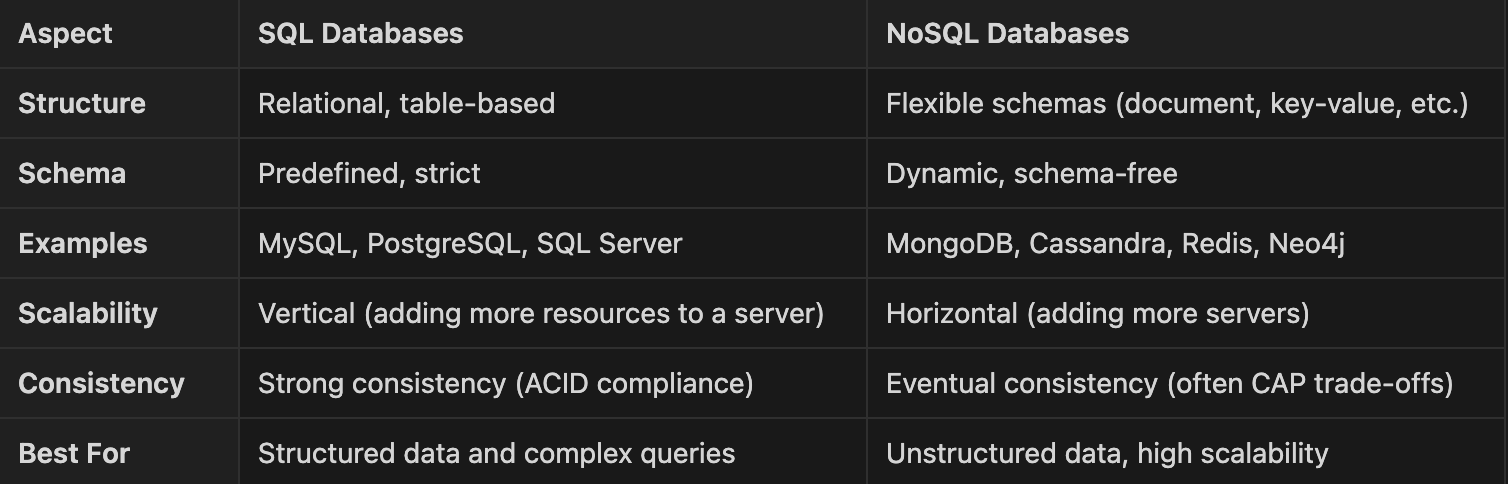
SQL vs. NoSQL: Key Differences
To make the distinctions between SQL and NoSQL more visually appealing, here’s a comparison table:
Common Database Structures
Beyond SQL and NoSQL, understanding specific database structures helps you match their capabilities to your product’s needs:
Relational Databases: Tables with predefined relationships. Best for structured data and complex relationships (e.g., e-commerce catalogs).
Document Stores: JSON-like documents. Best for flexible data models (e.g., content management systems).
Key-Value Stores: Simple key-value pairs for quick lookups. Best for caching and session management (e.g., Redis).
Graph Databases: Nodes and edges to model connections. Best for network analysis (e.g., social networks).
Column-Family Stores: Columns grouped for efficient querying. Best for high-performance write operations (e.g., Cassandra).
Choosing the Right Database for Your Product
Selecting a database requires aligning technical capabilities with business goals. Here are key factors to consider:
Data Structure: Is your data structured, semi-structured, or unstructured?
Scalability Needs: Will your product handle massive growth? NoSQL often excels here.
Query Requirements: Do you need complex queries? SQL databases are better for intricate relationships.
Consistency vs. Availability: Is strict data consistency critical? SQL databases prioritize ACID properties.
Speed and Performance: Do you need real-time responses? Consider low-latency options like key-value stores.
Cost and Maintenance: What are your resource constraints? Managed database services (e.g., AWS RDS) reduce overhead.
Common Pitfalls to Avoid
Overengineering: Choosing a database that’s overly complex for your needs can lead to inefficiencies and wasted resources.
Neglecting Scalability: Not planning for growth can result in performance bottlenecks as your user base expands.
Ignoring Team Expertise: Opting for a database unfamiliar to your team can increase learning curves and delay timelines.
Failing to Consider Costs: Some databases may seem appealing but come with high operational or licensing costs.
Resources to Learn More About Databases
Here are some external resources to deepen your understanding:
Books:
Online Courses:
Web Articles and Tutorials:
Communities:
Conclusion
Understanding databases is a valuable skill for product managers. By grasping the differences between SQL and NoSQL, recognizing various database structures, and aligning your choice with product needs, you can effectively guide technical discussions and contribute to a robust product architecture.
As you dive deeper into technical concepts, remember that collaboration with your engineering team is key. Ask questions, seek clarification, and build a shared understanding to ensure your product thrives.