
Ultimate Guide to REST API for Product Managers
What Are REST APIs, and Why Should You Care?

In today’s interconnected digital ecosystem, APIs (Application Programming Interfaces) are the invisible force driving most technological advancements. Whether it’s enabling seamless data exchange, powering third-party integrations, or facilitating cloud-based services, APIs are at the core of modern software. For product managers, understanding APIs isn’t just a technical necessity—it’s a strategic advantage.
Bridging the Gap: Understanding Client-Server Communication
At its core, modern software systems are built on the foundation of client-server communication. The client is the application or device making a request, such as a mobile app or web browser. The server is the system that processes the request and sends back the necessary data or performs an action. This interaction forms the backbone of Application Programming Interfaces (APIs), which enable seamless exchanges of information between disparate systems.
APIs Demystified: What They Are and Why They Matter
An API (Application Programming Interface) is a set of rules and protocols that dictate how software applications interact. Think of APIs as a translator that enables different systems to communicate, even if they are built using entirely different technologies.
Breaking Down API Communication: An Example
Consider this scenario: you want your app to display the current weather in a user’s city. Here’s how an API facilitates this:
Request: Your app (client) sends a request to a weather API, specifying the city name.
Processing: The API server retrieves the necessary weather data.
Response: The server sends the data back to your app, which formats it for the user.
Example Request and Response:
Request:
GET /weather?city=NewYork HTTP/1.1
Host: api.weather.com
Authorization: Bearer YOUR_API_KEY
Response:
{
  "city": "New York",
  "temperature": "15°C",
  "condition": "Partly Cloudy",
  "humidity": "78%"
}
This straightforward exchange exemplifies how APIs allow applications to deliver features without reinventing the wheel.
Enhancing Communication and Collaboration
A product manager who understands APIs can bridge the gap between technical teams and stakeholders. By grasping how APIs work, PMs can better articulate requirements, understand developer concerns, and ensure alignment across teams.
Enabling Feasibility and Innovation
APIs empower PMs to evaluate the feasibility of features, choose the right integrations, and innovate by leveraging external services. For instance, integrating a payment gateway like Stripe via its API can enable seamless transactions without building complex payment systems from scratch.
Understanding limitations, making intelligent trade-offs
Product managers must navigate the inherent trade-offs involved in API integrations, balancing scale, performance, security, and cost. For example, adding a real-time API may improve user experience but could significantly increase server costs or introduce latency issues. PMs need to work closely with technical teams to identify the most critical priorities, such as optimizing API call frequency to manage rate limits or ensuring that APIs are secure to prevent data breaches. Making these intelligent trade-offs is essential to delivering a scalable and reliable product while staying within budget.
Understand the complexities of scale, performance, security, and cost - elaborate on this
Standing Out in Interviews
API knowledge showcases technical acumen and problem-solving abilities, crucial traits for a PM role. Interview scenarios often involve designing solutions or integrating third-party tools, where understanding APIs proves invaluable.
Key Concepts
Before diving into the tools for working with APIs, it is essential to understand several fundamental concepts that underpin how APIs function and their significance in product management.
Authentication and Authorization
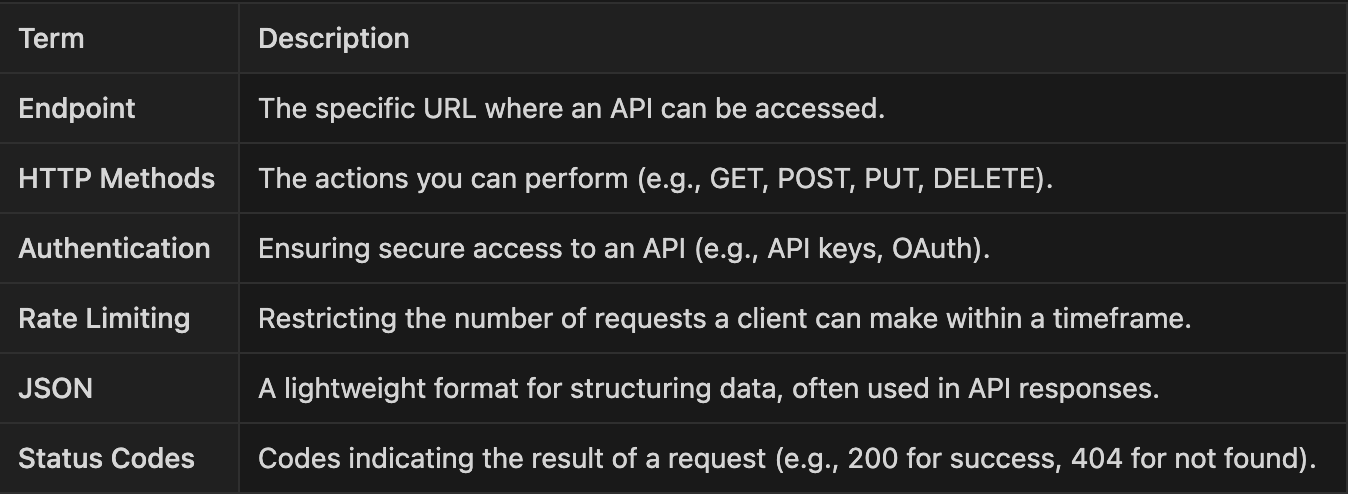
APIs often require secure mechanisms to verify the identity of clients accessing them. Authentication ensures that the entity making the request is genuine, commonly implemented through API keys, OAuth tokens, or JWT (JSON Web Tokens). OAuth is widely used for delegated access, allowing third-party apps to interact on behalf of a user without exposing credentials. Authorization, on the other hand, determines the permissions of an authenticated client, defining what data or actions it can access. For example, a user may be authenticated but restricted to read-only access for certain API endpoints.
Endpoints and HTTP Methods
Endpoints are the access points for APIs, represented as URLs where specific resources can be interacted with. These endpoints work in conjunction with HTTP methods to define actions. For instance:
GET retrieves data (e.g., fetching user details).
POST creates new data (e.g., adding a new user).
PUT updates existing data (e.g., modifying user details).
DELETE removes data (e.g., deleting a user).
Understanding the combination of endpoints and HTTP methods is key to designing and consuming APIs effectively. An endpoint is the specific URL where an API can be accessed. HTTP methods such as GET, POST, PUT, and DELETE define the action the client wishes to perform at the endpoint. For instance, GET retrieves data, while POST submits new data.
Rate Limiting and Throttling
APIs implement rate limiting to prevent excessive usage and ensure equitable access for all clients. Rate limits are often specified in terms of the number of requests allowed per second, minute, or day. Exceeding these limits can result in throttling, where additional requests are temporarily blocked. This mechanism safeguards API stability and ensures backend systems aren't overwhelmed. For example, a weather API might allow 100 requests per minute per client, ensuring fair usage across all consumers.
Status Codes and Error Handling
APIs use HTTP status codes to indicate the outcome of a request. These codes are categorized as follows:
2xx (Success): The request was successfully processed (e.g., 200 for OK, 201 for Created).
4xx (Client Errors): There was an issue with the request (e.g., 400 for Bad Request, 404 for Not Found).
5xx (Server Errors): The server encountered an error (e.g., 500 for Internal Server Error).
Effective error handling involves not only interpreting these codes but also parsing detailed error messages returned in the response body. This approach helps developers identify and resolve issues quickly, ensuring robust and user-friendly applications. APIs return status codes to indicate the outcome of a request. For example, 200 means success, 404 indicates the resource was not found, and 500 signifies a server error. Proper error handling ensures robust applications that can gracefully handle API failures.
Key Terminologies
Tools for Product Managers to Work with APIs
Tools like Postman, Swagger, and API gateways simplify working with APIs and are essential for product managers to understand their functionalities and capabilities.
Postman
Postman is a versatile tool for testing APIs. It allows users to compose requests, inspect responses, and automate tests. For PMs, Postman is helpful in verifying whether an API meets the functional requirements outlined in the product plan. It also serves as a quick way to prototype integrations without needing to write code.
Swagger (OpenAPI)
Swagger, or the OpenAPI specification, focuses on designing and documenting APIs. It provides an interactive interface where users can explore available endpoints, test API requests, and ensure alignment between developers and stakeholders. Swagger helps PMs understand the scope of an API and its potential impact on the product.
API Gateways
API Gateways play a pivotal role in the management and operation of APIs. They act as intermediaries between clients and backend services, providing essential features such as request routing, authentication, rate limiting, and analytics. For instance, AWS API Gateway enables developers to create, publish, and secure APIs at scale. From a product management perspective, understanding API gateways is crucial when orchestrating large-scale integrations, ensuring API performance, and maintaining security.
Learn more about AWS API Gateway.
API Gateways provide centralized management for APIs. They help monitor usage, enforce security protocols, and enable versioning. For PMs, understanding API gateways is crucial when managing large-scale API integrations or ensuring performance and reliability.