
Platform vs Core vs Technical PM


Product Management (PM) is an umbrella term that encompasses a wide variety of roles, each tailored to specific areas of expertise, responsibilities, and goals. Whether you're transitioning into product management or looking to specialize, understanding these nuances can help you chart your career path effectively.
In this article, we’ll explore the major PM role types, detailing their responsibilities and key differences. Special focus will be given to Core PM, Platform PM, and Technical Product Manager (TPM) roles, as they represent some of the most pivotal functions in the product ecosystem.
The Major PM Role Types
1. Core Product Manager (Core PM)
Core PMs focus on end-user-facing features and functionalities, driving the product's overall vision and ensuring its success in the market.
2. Platform Product Manager (Platform PM)
Platform PMs work behind the scenes to build the foundational systems, APIs, and tools that power multiple products or services within an organization.
3. Technical Product Manager (TPM)
TPMs bridge the gap between deeply technical teams and broader business goals, ensuring technical feasibility and alignment with the product strategy.
4. Growth Product Manager (Growth PM)
Growth PMs focus on driving user acquisition, retention, and engagement. Their work is often data-driven, relying on experiments and A/B testing.
5. Data Product Manager
These PMs specialize in products or features that revolve around data—think dashboards, analytics tools, or data pipelines.
6. AI/ML Product Manager
Focused on leveraging artificial intelligence and machine learning to create innovative products, these PMs work in rapidly evolving and technical domains.
7. Product Owner (PO)
Often confused with PMs, Product Owners primarily focus on the tactical execution of the product backlog in Agile development environments.
Detailed Breakdown: Core PM vs. Platform PM vs. TPM
1. Core Product Manager
Primary Focus: End-user experience and market impact.
Responsibilities:
Conduct user research to identify pain points and opportunities.
Define product features and prioritize them based on user needs and business goals.
Collaborate with design, engineering, and marketing teams to ship features.
Analyze product performance using metrics like MAUs (Monthly Active Users), retention, and NPS (Net Promoter Score).
Key Metrics:
User engagement (DAU, MAU).
Customer satisfaction (NPS).
Revenue growth or ARR (Annual Recurring Revenue).
Example Role:
A Core PM at Spotify may prioritize creating a "personalized playlist" feature, working closely with designers and engineers to ensure the user interface is intuitive and engaging.
2. Platform Product Manager
Primary Focus: Building scalable and reusable infrastructure that supports multiple products.
Responsibilities:
Define and prioritize internal tools, systems, and APIs.
Collaborate with engineering teams to ensure performance, scalability, and reliability.
Act as a liaison between Core PMs and technical teams, aligning platform capabilities with product needs.
Focus on reducing technical debt and improving developer productivity.
Key Metrics:
System reliability (uptime, latency).
Developer adoption of platform tools or APIs.
Cost efficiency and scalability.
Example Role:
A Platform PM at Uber might oversee the backend infrastructure for ride matching, ensuring the system can handle peak loads during events like New Year’s Eve.
3. Technical Product Manager (TPM)
Primary Focus: Overseeing technically complex products or systems while aligning them with broader business goals.
Responsibilities:
Understand technical architecture and constraints to guide product feasibility.
Write detailed technical requirements for engineering teams.
Collaborate closely with developers, often serving as a translator between technical and non-technical stakeholders.
Ensure projects are delivered on time and within scope, balancing technical debt with innovation.
Key Metrics:
Successful delivery of technical features or systems.
Alignment of engineering efforts with product roadmap.
System performance and security compliance.
Example Role:
A TPM at Google Cloud might lead the development of a new storage solution, working with engineering to ensure compatibility with existing cloud infrastructure.
Comparison Table: Core PM vs. Platform PM vs. TPM
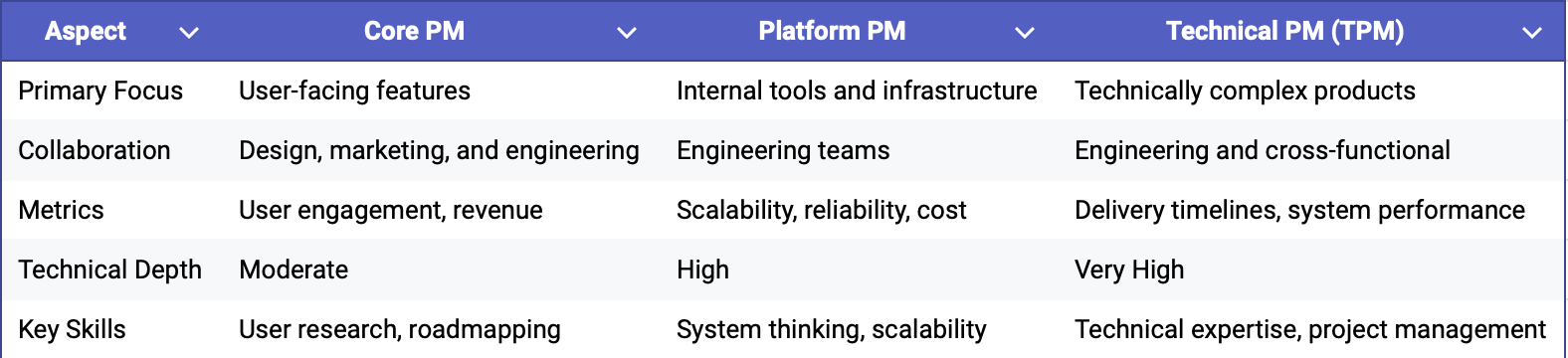
AspectCore PMPlatform PMTechnical PM (TPM)Primary FocusUser-facing featuresInternal tools and infrastructureTechnically complex productsCollaborationDesign, marketing, and engineeringEngineering teamsEngineering and cross-functionalMetricsUser engagement, revenueScalability, reliability, costDelivery timelines, system performanceTechnical DepthModerateHighVery HighKey SkillsUser research, roadmappingSystem thinking, scalabilityTechnical expertise, project management
How Roles Vary by Seniority
Entry-Level PMs: Likely to focus on execution-heavy roles, such as a Junior Core PM.
Mid-Level PMs: May take ownership of a platform or a larger feature set, with roles like Platform PM or TPM.
Senior PMs: Focus on strategy, aligning product direction with business objectives. Senior TPMs often manage cross-team initiatives.
Leadership (Group PM, Director): Oversee multiple teams or product areas, balancing innovation and operational excellence.
Why It Matters to Specialize
Career Alignment: Choosing the right PM role ensures alignment with your strengths and interests. For instance, a technically inclined PM might thrive as a TPM.
Clearer Pathways: Different roles lead to distinct growth opportunities. For example, a Platform PM role may lead to engineering leadership, while a Core PM could pivot to marketing or strategy.
Industry Demand: Certain roles, like Platform PMs, are increasingly in demand as companies scale.
Conclusion
Whether you’re drawn to user-facing features as a Core PM, the foundational architecture as a Platform PM, or technically challenging problems as a TPM, understanding these roles helps you carve out a fulfilling career in product management.
Each role is critical to delivering world-class products, and the best companies recognize that their success depends on the synergy between these distinct PM functions.